

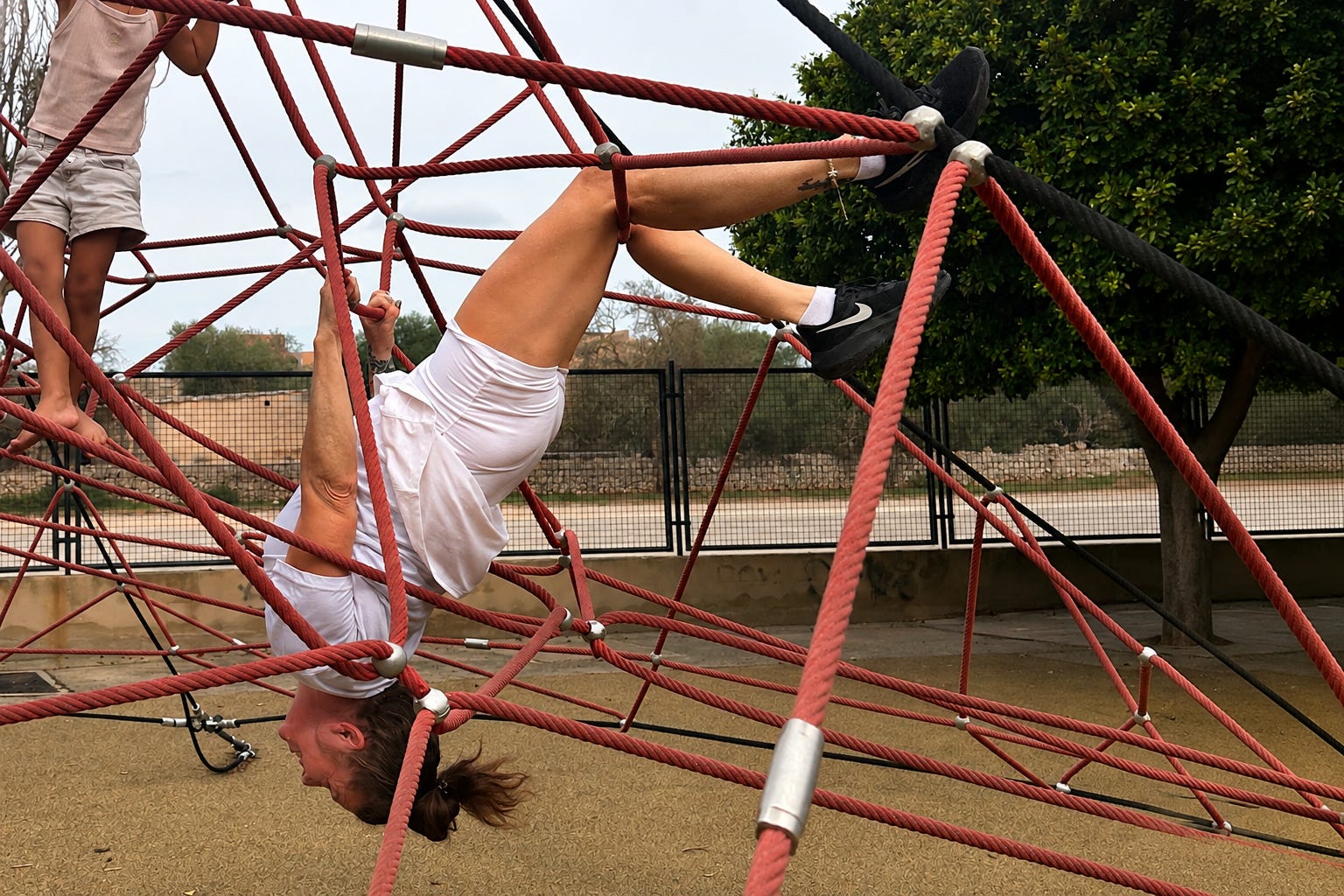
There is a great deal of talk about reinventing ourselves as we get older, especially after menopause. It’s interesting because women have never really been encouraged to reinvent themselves at this stage of life. If anything, we have been expected to fade silently into obscurity. The idea of reinvention has an appeal; the possibility of becoming what we believe we want to be. I have tried it myself.
Many years ago, I moved to another country where nobody really knew me. They didn’t know my history, my family, the things that had happened to me or the person I had been before I arrived. It was wonderful, I could be whoever I wanted to be, basically inventing myself. So that’s what I did. I would be cool and sophisticated, composed and together, the perfect image of the woman I wanted to be. She was a perfected version of myself.
What I didn’t understand was that this idealised version of myself was only a small part of who I am. To be her, I had to push down everything that didn’t fit the image: the wildness, the spontaneity, the loudness, the intensity, all the parts of me that had so often been rejected as too much. All the parts I had learned to control and contain to fit in.
And the thing is that I love those parts of myself. I am wild and spontaneous. I can be loud and I laugh a lot. I have a great deal of energy and enthusiasm, and I am, as I have been told more than once in my life, a lot. Yet when I can be all of that, I feel so free, happy and creative.
But I learned, from very early on, that this version of me wasn’t acceptable for the world around me. I was told to shush, calm down, behave, stop taking up so much space. There was always a sense that I needed to turn the volume down if I wanted to fit in and be accepted. So the parts of myself that made me feel most alive were also the parts I learned to diminish.
Like so many girls, I learned that there were certain expectations on how a girl should act and behave: don’t be too loud, don’t take up too much space, don’t be too much, calm down, behave yourself. We clearly understood that we had to adjust ourselves in order to be accepted.
I became good at reading the room, understanding what was expected of me and presenting the version of myself that seemed acceptable. I learned to notice what brought approval and what didn’t. After enough years, it becomes difficult to know where identity ends and adaptation begins.
Growing up, I was surrounded by mixed signals about who I was supposed, or expected, to be. The rules seemed to change depending on where I was and who I was with. There were double standards, contradictions and expectations I never quite understood. I spent so much time trying to work out how I was supposed to behave, what I was allowed to show and which parts of myself were acceptable that somewhere in all that confusion, I lost sight of myself and I started performing.
Playing a role for a while is possible, but living inside it is another matter. Life is not a theatre where we can stay on stage twenty-four hours a day, permanently prepared and performing the character we have chosen. Eventually, who we really are begins pushing its way through.
I also came to understand why those parts of me would sometimes come bursting out with such force. When something powerful has been suppressed for years, it will burst out when we finally give it room. I had to learn how to be at peace and balanced with my wild nature rather than clamping it down or allowing it to run away with me.
Years later, I moved countries again and found myself facing that same delicious possibility. Nobody here knows me. I can be whoever I want…
This time I wanted to be the maximum of myself.
That was the freedom I had been looking for all along. I had thought freedom meant having the opportunity to construct a new identity. What I wanted was to discover myself and have the freedom to be exactly who I am. Self-discovery is harder than reinvention. Because discovering ourselves means that we have to face everything we would rather leave undiscovered. The anger, shame, fear, grief and choices we pushed away because we could not deal with them at the time, and the experiences that shaped us, the ways we learned to protect ourselves, and the difficult work of understanding what belongs to us and what we took on along the way.
We cannot become fully ourselves while large parts of our lives stay hidden in the shadows. What we refuse to look at continues to influence our choices, our relationships and the way we see ourselves. The shadows keep us stuck in old patterns.
This is why I believe that there is an important difference between reinventing ourselves and discovering ourselves. Reinvention can become another performance. We decide who the new woman is, leaving the deeper aspects of ourselves behind. Self-discovery asks us to find out who we really are.
For women, I think this becomes especially important after menopause because so many of the structures that shaped our identity start falling apart. The roles we performed, the approval we sought, the responsibilities that were put on us, and the ways we learned to fit into the world no longer have the same hold over us. We have an opportunity to see who we are when we stop organising ourselves around who everyone else wants us to be.
Perhaps that is one of the great possibilities in this beautiful part of life. We finally have enough experience to recognise the roles we have been playing, enough wisdom to understand why we needed them, and time to find out who we are when we no longer have to fit ourselves into the tiny box we were given.
I am not interested in reinventing myself. I want to discover every aspect of who I am and what I came here to do. I want to live in my glorious wildness.