

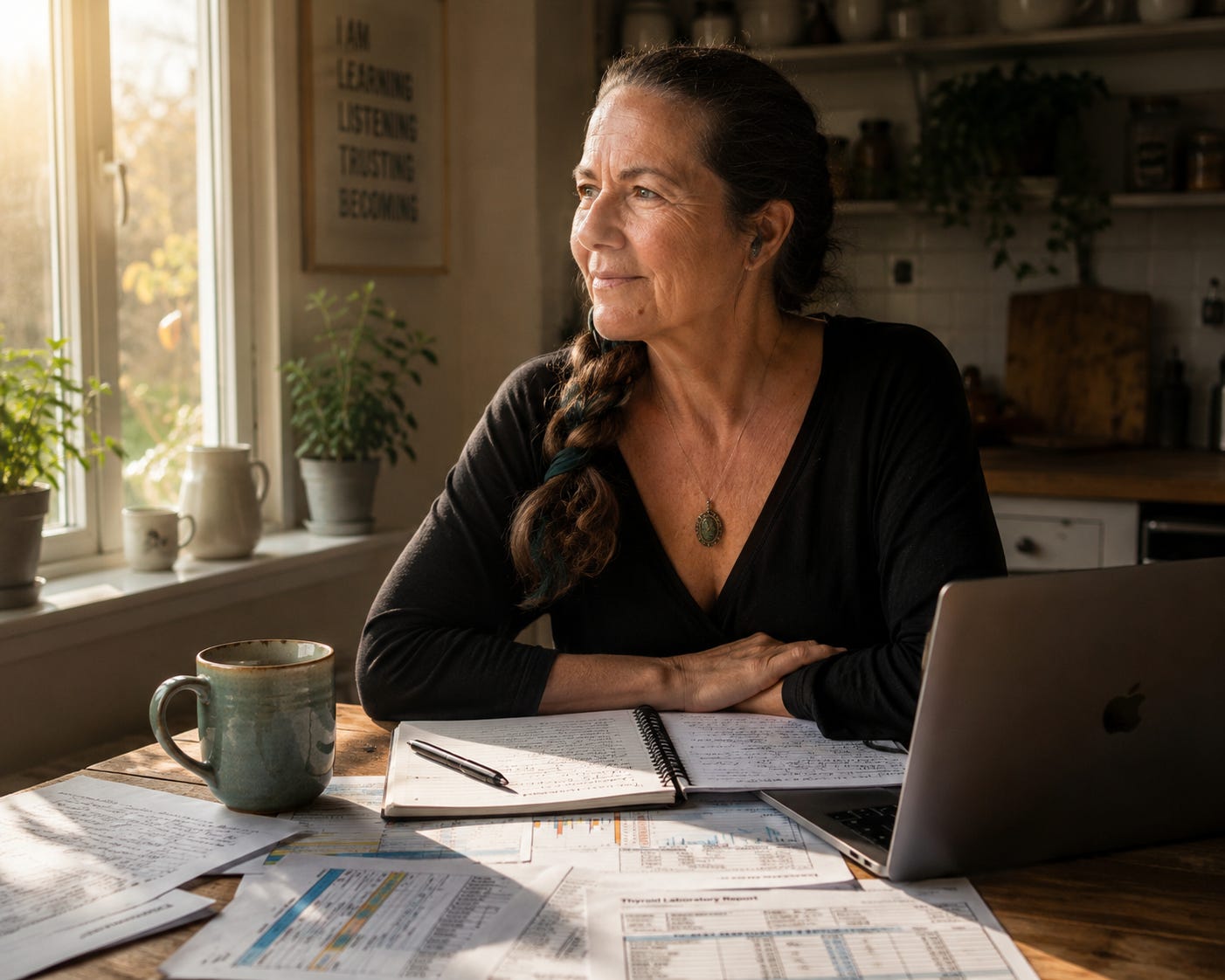
I was strong and fit through my fifties, hardly touched by menopause until sixty arrived and brought everything at once: the weight, the sleeplessness, the pain and the fog that stole my words.
I had never experienced anything like it. My body had always looked after me, so when it suddenly gave up, I made an appointment with my GP, convinced there had to be an explanation for what was happening. She ordered blood tests which showed hypothyroidism and Hashimoto’s autoimmune disease. She started me on medication and referred me to an endocrinologist.
I took the medication faithfully and waited for my body to respond. Weeks turned into months and still I got worse. The weight climbed, sleep became elusive, my brain went AWOL and the exhaustion settled so deeply into my body that having energy again began to feel like a dream.
I waited impatiently for the appointment with the endocrinologist but it took eight months before I finally got to see him. When I finally walked into his office, I had been living with this for over a year and I was an absolute wreck. I was hopeful because I was finally going to get an explanation for what was happening inside my body and, more importantly, a plan that would help me get well again.
I explained what had been happening over the previous months, how the medication hadn’t helped and how I was continuing to get worse. He looked at me and said;
“Eat less and move more.”
I was so shocked that I couldn’t think clearly. I didn’t know what to say. I just sat there, numb. In that moment I saw myself staying in this horrible state with no hope of ever getting well again. It broke my heart and it felt like the rug was pulled out from under my feet. I was frightened.
I don’t remember the drive home, only that I was crying and feeling devastated.
I don’t think he meant to be unkind. I think he believed what he was telling me; that because I was an “older” woman, my state of health was to be expected. He made it sound so final, as if he had seen it over and over again; the deterioration of a woman once she passed the menopause threshold.
The next morning I woke up angry.
I was angry that I had waited more than a year for help only to be told that there was nothing to be done. Angry that I, who had been healthy, active and full of life, could be reduced to something so inconsequential and I made a decision:
If nobody else was going to work this out for me, I would.
I made myself a cup of coffee, sat down at my computer and typed two words into Google: hypothyroidism and Hashimoto’s. Then I went down the first rabbit hole of many. I read research papers, medical journals and just about everything else I could find. I kept detailed records, tracked every blood test and approached my own health as methodically as I knew how. If I was going to understand, and heal, what was happening inside my body, I needed evidence, not guesswork.
I applied what I learned to myself and my life, and then something changed. I started sleeping. It sounds like such a small thing until you’ve spent months lying awake night after night, wondering whether you’re ever going to be okay again. That morning I knew that I was on the right track. Every improvement became another confirmation that I was moving in the right direction. I wasn’t guessing anymore. I was learning.
At my next appointment with my GP, I told her everything I had been doing. I explained how I was feeling, why I believed the medication wasn’t working as it should and why I wanted to try a different approach. I walked her through everything I had learned, the changes I had already made and the results I was beginning to see.
I told her I needed her support. There were blood tests I couldn’t order myself and medications I couldn’t access without a prescription. If I was going to continue, I needed the freedom to explore what was working while knowing I had a doctor beside me.
She listened as I showed her all my research and paperwork. After looking at it, she said, “You know more about this than I do. Tell me what you need, and I’ll support you.” I could have kissed her!
From that day on I had a partner in my healing.
Six months later I walked back into the endocrinologist’s office carrying a folder with my spreadsheets, every blood test I had taken, a dated record of the changes I had made and the results. My body was changing, my numbers were looking good and I was feeling so much better. Now he would sit up and pay attention. But nope. He looked through the spreadsheet, then searched my file for the notes from my first appointment. There weren’t any. Nothing from that first consultation had been recorded.
He turned back to my spreadsheet, shook his head and told me it was just a fluke. Nothing would change the fact that my thyroid would gradually stop functioning and eventually disappear. This was just how the disease progressed. I challenged him. I pointed to the numbers, explained the changes I had made and asked him how he could dismiss improvements that were right there in front of him. He brushed me off and I could see that he found me both silly and tiresome.
I walked out of his office knowing I was on the right track. My body was responding and my blood tests were improving. That was all the evidence I needed to continue. I decided to ask for a second opinion.
I walked out of his office knowing I was on the right track, and I asked for a second opinion.
Another eight months later I sat in front of a woman in her forties. I was sure that another specialist, and especially a woman, would see my progress. I showed her the folder. She dismissed it, and although my condition needed ongoing monitoring, she never booked a follow-up. What angered me most was the disrespect.
A few days later I logged into my online medical record. There were no notes. Again.
I was on my own.
Ain’t nobody gonna tell me that I can’t.
I knew that there was a way. I needed to heal, I wanted to heal and I was going to heal, even if I had to do it on my own. If that meant reading another hundred research papers and continuing to experiment until I found what worked, then that was exactly what I would do. I knew that I was moving in the right direction, and I trusted what I was seeing and feeling. I stopped looking for someone to tell me what was possible. I kept learning, testing, refining, and with every improvement I knew I was right.
It took me three years.
Three years of changing every aspect of my life and learning to listen to my body in a way I never had before. It cost me my savings, it cost me time and sometimes I wondered if I was going crazy.
It was a lonely road and there were days when the fear and anxiety threatened to overwhelm me. Was I ever going to get well? Sometimes I just didn’t know what to do next, but then I would look at myself in the mirror and know that giving up wasn’t an option. I hated feeling so unwell. I hated what was happening to my body, and I knew there was only one thing to do:
Get up, keep learning and keep going.
Whenever I felt like giving up, I thought back to how I had felt at my worst. I never wanted to be in that place again and that was the incentive that kept me moving forward. Every month my health improved a little more. My body was responding, my blood tests were changing and my confidence grew.
For most of my life I had taken my health for granted because it had always been there. My body carried me through every challenge I placed before it and I expected it to keep doing so without asking very much in return. Hashimoto changed that relationship forever. I learned to listen instead of override, to become curious instead of dismissive and I learned that my body wasn’t a machine but a lifelong companion that deserved my respect and care.
It also taught me something about women’s place in society. It showed me how vulnerable we are at this deeply important time of our lives, post menopause, how unprepared and dismissed. For generations we have been silenced and marginalised and along the way we stopped listening to the wisdom within us because we have been taught not to trust it.
Our inner wisdom is still there. Sometimes we just need to remember that it belongs to us.
Every woman deserves to be heard, seen and respected.
Has this happened to you?
Amazing! Good work!
You are strong.