
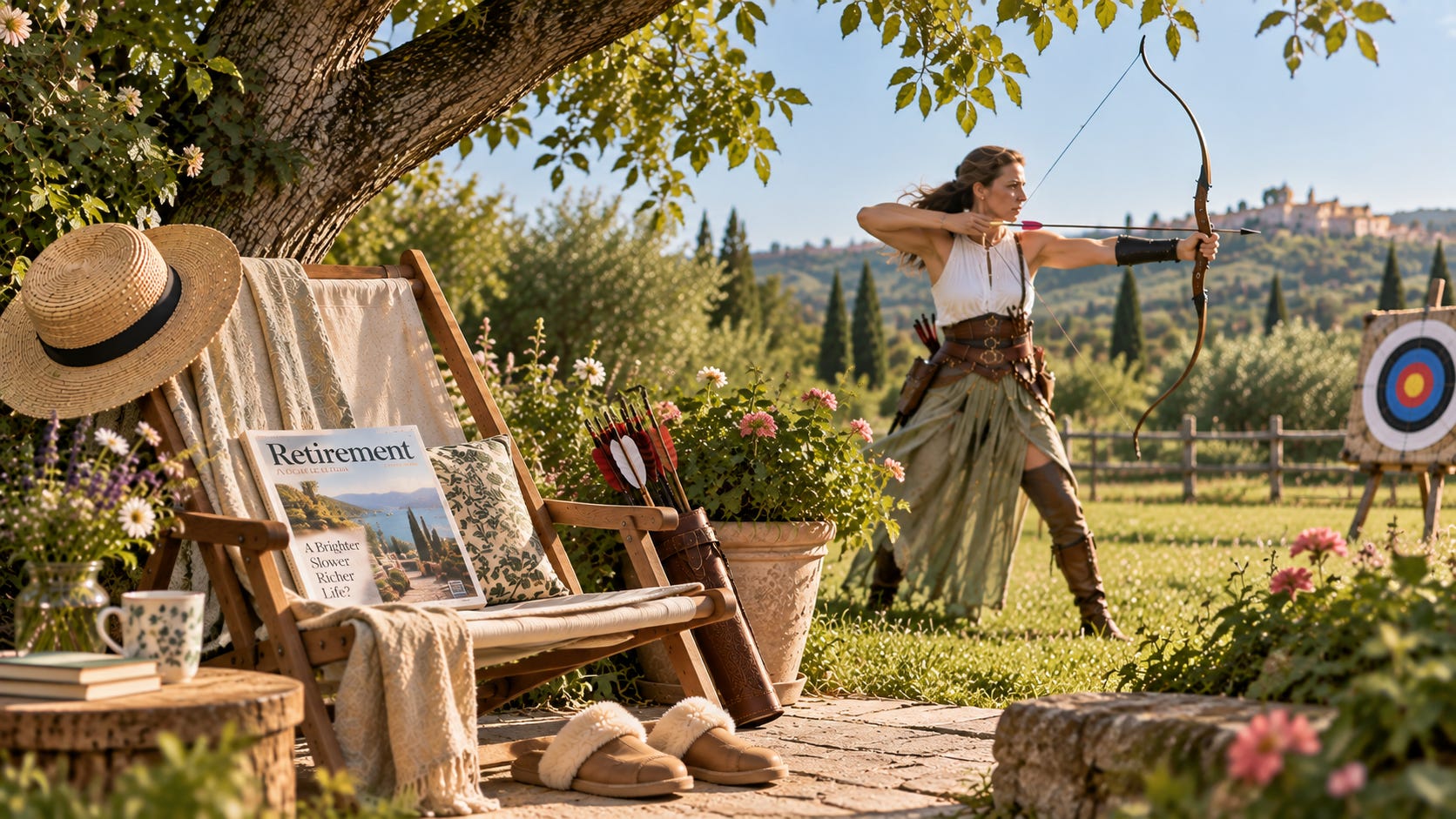
People have started asking me if I am retired, even before they ask me what I do. My answer is usually, “What do you mean by retired?”
“You know, that you don’t have to work anymore.”
I have always known I would never retire. I understand retiring from a job. You have done it for long enough, you want to stop, so you retire. Fine. What I don’t understand is how retired became something we are because we reach a certain age.
The word itself means to withdraw. In old novels people retire to bed, retire to the drawing room or retire from a conversation. Very elegant. I rather like the idea of announcing after dinner that I shall retire to my room. You retire from something or to somewhere. You don’t retire from life.
Yet when I hear the word retired, the picture in my head is old, tired, done, obsolete. I know plenty of people are happily retired and having a wonderful time. It is the word, and what we have attached to it, that bothers me.
Apparently, at my age, retirement is expected. When I say I am not retired, people ask me why, and I tell them, “Because I love what I do.”
I work because I can’t not work. My work is part of who I am and it gives meaning to my life. I have a huge vision for what I want to accomplish, and the older I get, the more experience I have to do it. Why would I stop now?
I don’t have a pension plan, so there is a practical reality to all this as well. But if I suddenly had enough money tomorrow that I never needed to earn another euro, I still wouldn’t retire. I would step it up. Money would give me more possibilities to do what I want to do. Financial freedom would give me more freedom to work.
So when someone looks at me and assumes retired, I find it strange. Nobody assumed anything when I was forty. They asked what I did. Now my age seems to answer the question before I do.
And that got me thinking about what we actually call this time of life.
We have names for almost every stage. We are babies, toddlers, children, adolescents, young adults, adults, and eventually we reach midlife. But what comes after midlife?
Apparently nothing.
I am post-menopausal, but that describes something my body has been through, not who I am. I didn’t call myself pre-menopausal when I was thirty-five, so why would I identify myself as post-menopausal now? Then there is old, a perfectly good word that has become so negative that most of us don’t want it. Or we can call these the golden years, which sounds like something from a retirement brochure.
And this is where retired slips in. We don’t seem to have a good name for this stage of life, so we identify people by the fact that they have stopped working, whether they have or not.
I could therefore be described as a post-menopausal, old, retired woman. What an extraordinarily uninspiring description of a woman who may have another thirty years to live. That description feels like an insult.
This could be a third of our lives, and we don’t even have a proper name for it. Most of the words we do have tell us what has already happened or what we have left behind. Post-menopausal. Retired. Past middle age.
Perhaps this is why the word retired bothers me. Retirement is a perfectly good word when somebody has actually retired. Some people can’t wait to retire and thoroughly enjoy it. Good for them. But retired shouldn’t be a catch-all title for anybody over sixty. There should still be some curiosity about the individual.
Ask me what I do. Ask me what I am interested in, what I am planning, what I want to do next. You might discover that I am retired. You might discover something completely different.
Retire was once something you did. You retired from the table, from a conversation, from your occupation, or to bed at the end of the evening. Somewhere along the way, retired became something you are.
I would rather keep the verb.
And one day I may announce that I have finally retired. It will probably be to bed or my boudoir.
If you have a better name for that 3rd tridecade (last 30 years) of our lives, please hit reply and let me know. I need a word, a respectful word.