

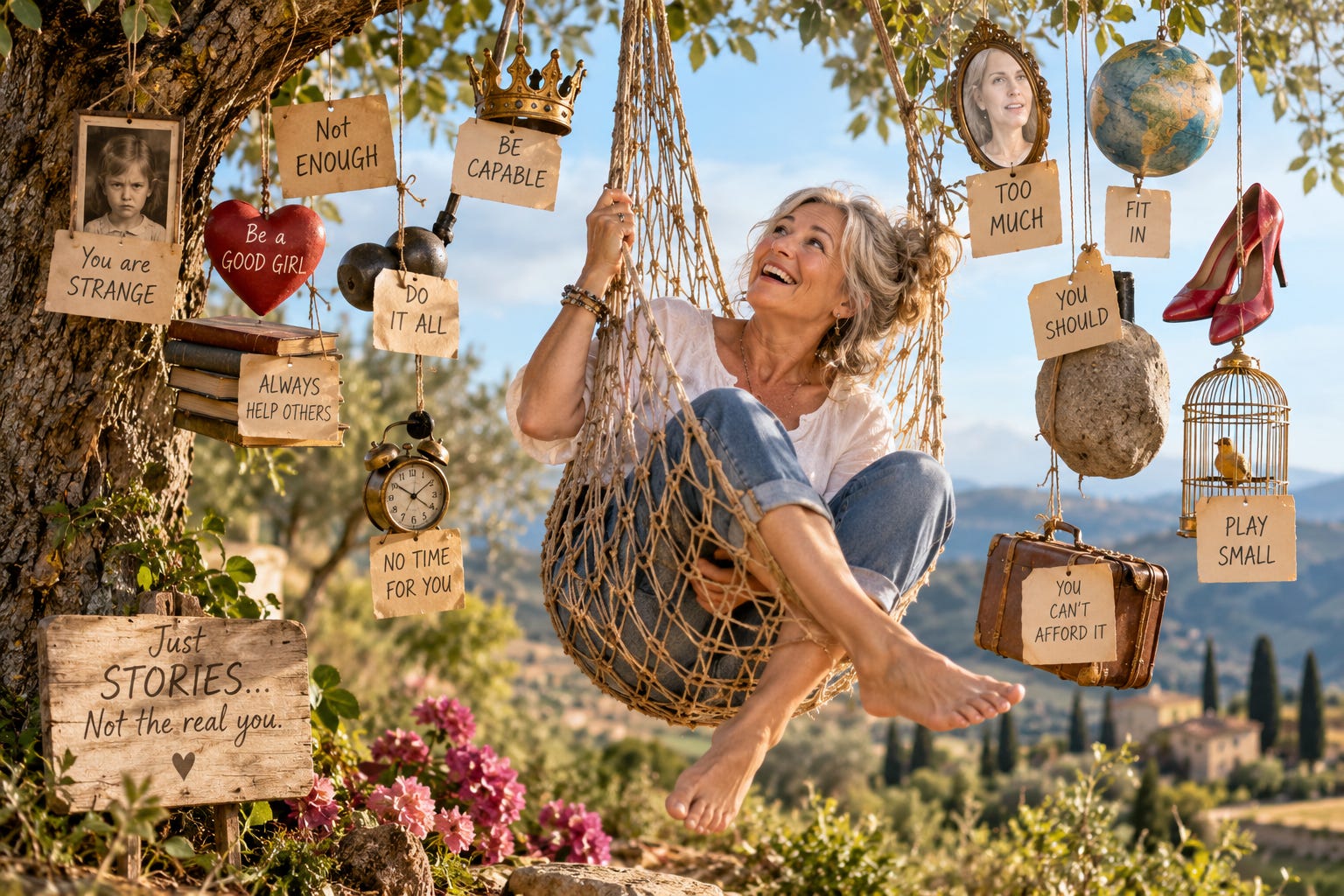
We all carry stories about who we are. Some of them have been with us for so long that they become explanations for what happens in our lives and the capabilities we might have - or not.
Usually they begin with what we are told: You are so and so, you always do this, you can’t do that… Sometimes they grow from experience, both good and bad, and the meaning we make from what happened. After enough repetition, we start living it, it becomes part of our identity.
One of mine was that I was strange.
Strange because I didn’t fit the norm which, in a way, was true. I have always chosen different and unexpected paths throughout my life, breaking societal norms, and there will always be people who think I am strange because of it. And that’s fine, the story itself wasn’t necessarily wrong. What trapped me was the constant negative repetition which over time was baked into my belief system, telling me that because of my strangeness, I didn’t belong. The worst part was that I loved my “strangeness” so it was very confusing.
When people didn’t take to me, I automatically thought it was because they found me strange, even when that might not have been true. Once I realised that, it still took time to change that conviction because the story had become part of how I saw myself in relation to other people.
This is why the stories we carry are so important to understand. They are more than thoughts.
Women in particular grow up with stories about being either not enough or too much. We are not smart enough, beautiful enough or good enough, while at the same time we can be too emotional, too demanding, too loud or too ambitious. We can never win. Women have lived with these expectations for centuries and there is a great deal of hurt and anger in that inheritance.
When anger has nowhere to go, it becomes internalised. Over the years I have seen it show itself physically and emotionally, through stress, depression, addictive behaviours and sometimes uncontrolled emotional overwhelm. Our emotional and physical systems are deeply connected. Then there is the story of the Good Girl; likeable, helpful, capable and dependable. It looks positive, which makes it harder to recognise as a story that can trap us.
Anything we put after the words “I am” deserves some attention because that has become an identity.
And this is where the brain becomes interesting.
Our basic set-up is biological, no matter how much we have evolved. One of the brain’s most important jobs is to keep us safe, and the amygdala is involved in looking for danger. That danger doesn’t have to be real. If the brain has learned to connect something with danger, the body can react as if it is.
So when a woman who has spent her life being useful starts taking time for herself, she may feel guilty or anxious. She knows she is doing nothing wrong, but the old story has been her normal for years. Knowing better or understanding the pattern isn’t always enough.
I get so frustrated with the “just do this” culture of personal development. We are far more complicated than that. Our brains carry thoughts, associations and programming that we’re barely conscious of. Our bodies are enormous interconnected systems, hormones influence us massively, emotions are experienced physically in the body and every single cell communicates with each other.
Changing a story therefore involves much more than deciding to think differently. Healing takes time.
The first thing to do is to start listening to yourself.
Pay attention to what you think and what you say, particularly the things you repeat. “I am...” “I always...” “I can’t...” “I should...” “People like me don’t...” Even statements such as “I have trauma,” “I have fear” or “I have insecurity” are worth hearing properly, because something can begin as an experience and eventually become how we define ourselves.
A story always comes from something real. Even imagination is real in the sense that we experience it as real. I don’t care where the story comes from, I care about what that story is doing to your life now and how it can be cleared.
One of the ways we can recognise a story that traps us is repetition. When a story is negative, painful or hopeless, it has nowhere to go and we keep telling ourselves the same thing over and over again. It becomes a loop, and the trick is to stop that loop. When I catch myself in a loop (and of course I have such negative stories and beliefs), I go for the complete opposite. It doesn’t matter if the opposite feels true or real at that moment. The point is to stop what has been going around in my head and think in a different way. Over time that different way becomes the new normal and I can change my life.
When you start doing this, you have to pay attention to yourself; What am I thinking? What am I saying? There is discipline involved because the old story has had years of practice and the new one is…new.
Journaling is very useful because it is a way of talking to yourself without the chatter of the brain. When I write, I can focus on what I am actually thinking and see the story with more clarity. I can see what words I use and from there I can stop the old story and start creating something new - using new words.
I call this rewriting the story. It doesn’t mean finding a positive affirmation and trying to convince yourself that it is true. Believing isn’t always the point; we believe all kinds of things that we know are not real or true. It’s about finding the story that fits with who you want to be now. You may not believe it completely in the beginning because you haven’t lived it yet. You grow into it by starting to live differently.
How do you know if the new story really belongs to you? For me, it is always about how it feels. When something comes from expectation, there is a negativity to it. I can feel it in my body and there is an underlying sadness or disappointment. When something feels right for me, my heart lightens and I feel excitement and happiness. There is almost a little high to it. We feel our emotions in the body, and I have learned to listen to that.
Then you have to start living the new story. You do things, learn things and create new habits that fit with who you want to be. You start doing things because you enjoy it and feel pleasure. This is part of the rewiring. You are doing something different and giving your brain and body a new experience, a new programming, a new story. With practice, what felt strange in the beginning becomes more natural and eventually it becomes your new normal.
Practice, practice, practice. Every day is a new day
The body has to be part of that process. I think of the body as our house, the place where we live our entire lives. Whatever happens to us will impact us there, and we need to keep that house in good repair. Proper nutrition, physical movement and relaxation is important. If anxiety is present, it needs to be dealt with. Breathing exercises can help break the cycle, movement works for many people, and once the physical intensity has settled enough, journaling can help focus the thoughts and turn them in another direction.
There is often grief involved.
There can be grief when we start seeing how much time and energy we have spent living by old stories and expectations, and I think some of the anger that comes up grows from that grief. We all deal with grief differently, but if you find yourself stuck in it, feeling like shit and nothing seems to change, ask for help.
Menopause changes us. There is a massive hormonal rearranging going on in our bodies that affects us physically and emotionally, changing our moods, energy, bodies and how we react to the world around us. At the same time, the years of societal demands are behind us, creating a freedom we didn’t have before.
We start paying more attention to ourselves, have less patience with rubbish and start questioning things we might have accepted for years. We come into this new space with a lifetime of experience. We recognise patterns because we have seen them before. There is knowledge here that only comes from living experience and now we have the opportunity to use it differently.
Becoming the Wise Elder.
She no longer needs to carry responsibility for other people’s wishes, whims and demands. Her experience can now serve through leadership. A wise elder guides. She recognises pitfalls, traps and patterns because she has seen them before, sometimes in her own life and sometimes in the lives around her. Guiding is different from telling another woman what to do. It is walking next to her through whatever may be happening and staying by her side while she finds her own way.
The Beauty of Transformation
Sometimes we can see our own stories and change them. Sometimes we are so deep and lost inside the story that we cannot see its edges anymore, and then we need the support and guidance of others to move out of it.
Changing our stories is work. There is no “just do this” answer because we are dealing with the whole woman, her thoughts, her emotions, her body, her experiences, her habits and the life she has built around who she believed herself to be.
When an old story limits us, we have the chance to create a story that fits who we are becoming, or what we always were, fulfilling our destiny. It is the sum of us: what we brought into this life, our experiences, our learning and everything we have gathered along the way. Much of that sits outside our conscious awareness until the pieces begin to fit together like a puzzle and we experience a sense of wholeness.
That moment when something inside us recognises: Aha, this is who I am.
If you recognise yourself in this and know there is an old story still running your life, this might be the time to look at it properly. Sometimes we can do this work ourselves and sometimes we need someone beside us who can see the patterns we cannot see ourselves. This is part of the work I do with women after menopause, helping you understand what is keeping you stuck and create a different way forward. If you feel ready to change your story, you can find out more about working with me below.