
For most of my life, being capable meant not needing help.
I loved the feeling of solving something difficult on my own, especially things that frightened me or that most people wouldn’t even attempt. There was enormous satisfaction in looking at a situation that seemed impossible and finding a way through it. I was Superwoman, entirely self-sufficient, able to deal with whatever life threw at me, and I was immensely proud of her.
There was also something underneath that pride that I understood much later: fear. Being capable made me feel safe. It made me feel that I had value, and the more difficult the challenge, the greater the proof. If I could handle it myself, nobody could touch me.
I learned that very young.
When I was around seven, my family moved from the country where I had been born to a country I had never been to before. In my birth country I had a nanny whom I trusted with my life. Then she was gone, and shortly after we arrived in this completely unfamiliar place, my parents travelled for two months and left us children with a young girl. I knew I was alone.
Somewhere in that experience I learned that I couldn’t assume somebody would stand up for me. I didn’t trust that other people would be there when I needed them, so I became the person I could depend upon. And I became very good at it.
I never asked for help or support. I took risks because there was a part of me that believed I could find a way through whatever happened. I wanted to feel proud of myself; I needed it. I wanted the evidence that I was capable and valuable, and that nobody could touch me.
It gave me freedom, and it gave me loneliness. I knew both from the beginning, and for a very long time the freedom was worth the price.
Years later I had a child on my own, and motherhood took my capability to another level. I went from capable to Superwoman galore. Nothing daunted me.
Eventually I met a man who loved us. I don’t think I ever completely learned to rely on him for myself, but I could rely on him with my child and, later, with our children. He was an amazing father. I think, in hindsight, that part of me chose him for my daughter. I wanted her to have something I had never had: someone she knew would always be there for her.
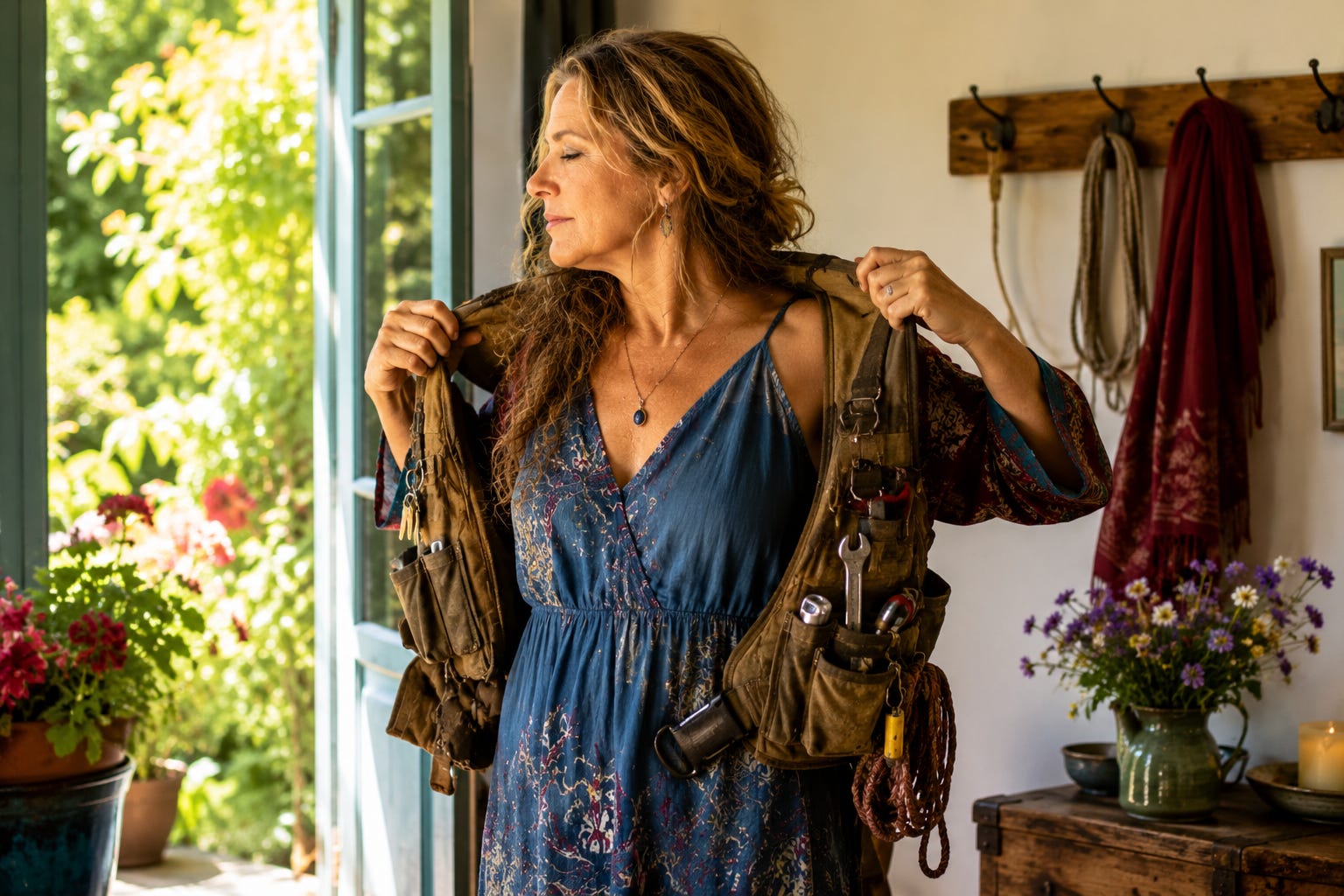
We built a life together in the forest with our children and animals. When my man developed a physical disability, I took on the physical work of running our small homestead while he worked and brought in the salary that allowed us to live. I gardened, cared for the animals, heated the house with wood and chopped that wood myself. I did repairs, renovations and whatever else needed doing, alongside my work with botanicals.
And I loved it.
This matters to me because it would be easy to look back and turn all that capability into a problem. It wasn’t. I was satisfied. I loved my life in the forest, surrounded by children, animals and plants. Being strong and capable allowed me to create and sustain a life that meant everything to me.
There were also moments when that capacity became almost extraordinary.
I remember one magnificent storm when the roof of the house collapsed. I was alone and had absolutely no idea what to do. It was an emergency in the truest sense; something had to happen now.
My nervous system has an interesting way of dealing with situations like that. Everything freezes and my mind becomes super sharp. I figured out what needed to be done and did it.
Afterwards, I felt grateful to myself.
Grateful that I had the capacity to deal with something so stressful and frightening without crashing. Experiences like that strengthened my trust in myself. Whatever happened, I knew there was a part of me that could step forward and deal with it.
For most of my life my body came along for the ride. I always had excellent health, and I asked an enormous amount of myself without really questioning whether there might eventually be a limit.
Then menopause arrived, followed by hypothyroidism and Hashimoto’s, and for the first time my body could no longer keep up with the woman I had always been. I had spent a lifetime trusting my ability to push through, solve the problem and carry on. Suddenly, that certainty was gone.
Superwoman immediately went to work. I learned everything I could about what was happening to me and what I could do to help myself. That part of me was still there, researching, learning, looking for answers and refusing to give up. I was frightened and completely out of my depth, but I still had the one way of dealing with difficulty that had served me all my life: Superwoman.
But underneath her, I was stunned, scared, insecure and very lost.
For perhaps the first time, the woman who had built her identity around being able to deal with anything had to acknowledge that she was vulnerable.
This was when something began to change.
My children had always known Superwoman, and now, for the first time, I was honest with them about my weakness. I allowed them to see that I was frightened and struggling, and they were there for me. They supported me in many different ways and made it clear that they were ready to help whenever I needed them.
At my weakest, they told me I was their role model.
That affected me deeply and I began to understand strength differently. I had spent so much of my life believing that strength meant being able to stand alone. Yet here I was, allowing the people I loved to see my vulnerability, and somehow I did not become less in their eyes. My understanding of strength became more realistic and balanced.
Post-menopause has also changed the way I see my strength and what I want to use it for. For most of my life there was always something or someone that needed me; children, work, animals, a home, problems to solve and things that had to be done. I was very good at that life and much of it gave me enormous pleasure.
Now I have reached a stage where I don’t have to prove my value by constantly doing, fixing and coping. Post-menopause has stripped away my need to perform for the world around me and brought me back to myself. I decide what I want to do with all this capability, experience and strength.
Weakness is part of being human. At one time or another, every one of us will experience it. Accepting that has not diminished my strength. In some ways, my strength has become deeper and more stable because it is no longer built on fear.
I am still Superwoman. She is part of my identity and I have no desire to get rid of her. I love her. I love knowing that when something difficult happens, there is a woman inside me who can become super sharp, assess the situation and do what needs to be done. I love the freedom and possibilities my strength gives me.
The difference is that I allow myself the peace of not constantly using her.
I recognise the old Superwoman in many of the women I meet and work with. They are immensely capable. They have spent decades coping, solving, caring, organising, working and being the person everybody can rely upon. Often, underneath all that competence, I recognise the fear of vulnerability.
It may not even have a name. Mine didn’t.
What my own experience has taught me is that strength doesn’t diminish when we accept our vulnerability. It becomes something we can use rather than something we have to prove.
My strength today comes from self-knowledge and pleasure.
I feel pleasure when I experience my own strength because it gives me so many possibilities. It is beautiful and wild and strong, and sometimes it wants to curl up and rest. Both belong to me.
Perhaps this is one of the greatest changes that has come with this stage of my life. I no longer need my capability primarily to cope with whatever life throws at me, I can use it to build my life as I want it.
When I think about that seven-year-old girl who realised she was essentially on her own and began building Superwoman, I don’t want to tell her to stop. She created something extraordinary that served me for decades.
I would tell her:
You already have all you need. Focus on what you want and know that you can do anything you like.
How much of who you are is still tied to how much you can handle?