

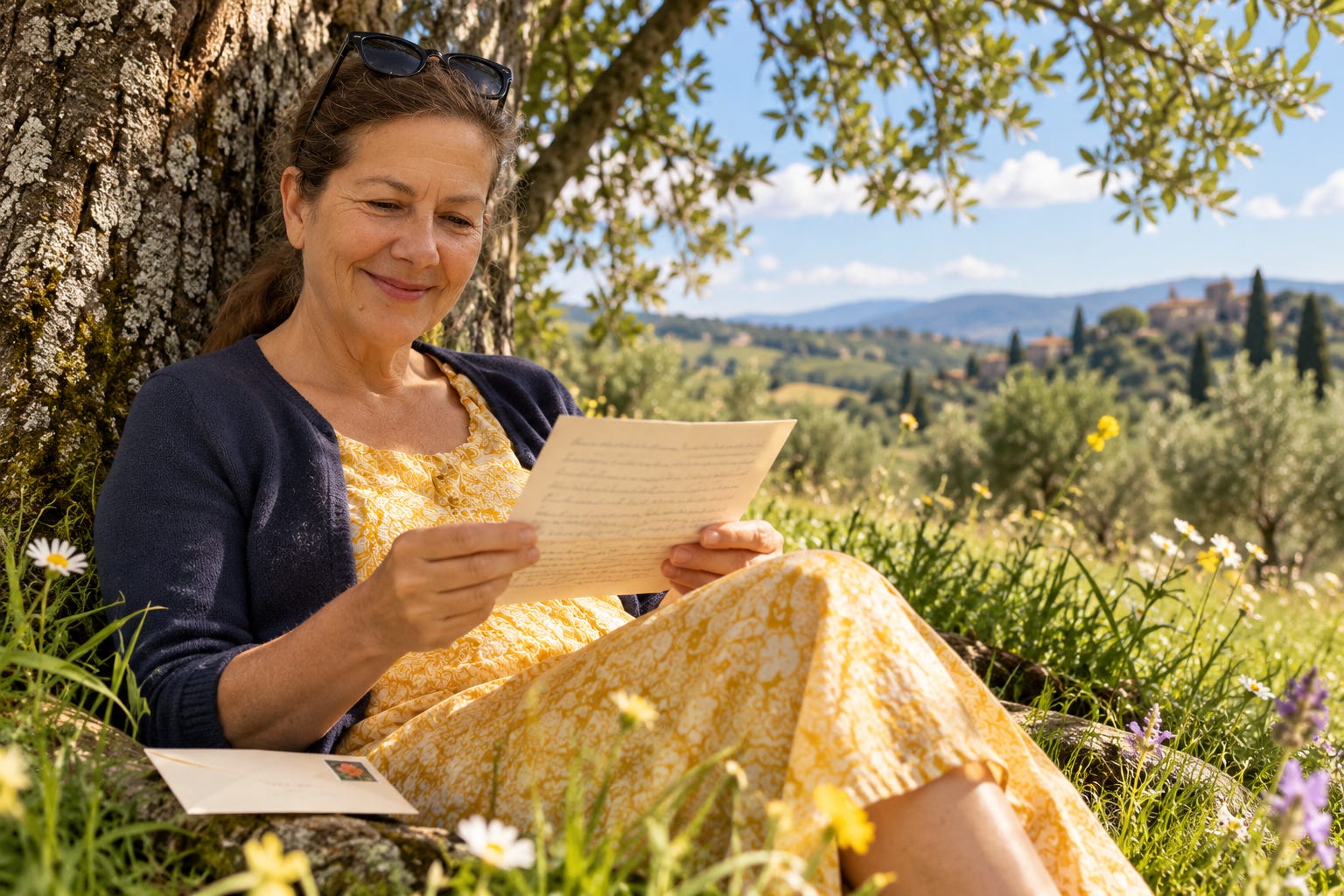
When I was young, everything took time. If you received a letter, you opened it and read it, probably more than once. You thought about what the person had written, what was happening in their life and what they might be going through. Then you thought about what you wanted to say in return, sat down with paper and pen and composed your answer. You read through it, folded the pages, put them in an envelope, found a stamp and went to the mailbox to post it. Then you waited.
Depending on where the person lived, it could take a week for your letter to arrive. They would open it, read it and go through the same process before writing back, so one exchange could easily take two weeks or more. This was completely normal. We expected communication to take time, and the time between sending something and receiving an answer was part of the process.
There was also something very physical about it. You held the paper someone else had held, saw their handwriting and perhaps recognised their mood from the way they had written. You chose your own paper, sat somewhere to write and physically carried your reply to the mailbox. Communication involved your hands, your body, a place and a series of actions, and between those actions there were periods when there was nothing more you could do. Once the letter had disappeared into the mailbox, it was gone. You carried on with your life until an answer arrived.
Photographs worked in much the same way. You took a photograph and had no idea whether it was good. You finished the film, took it somewhere to be developed and waited, sometimes for several days. Then you went back to collect that little envelope of photographs and sat down to look through them. Some were good, some were terrible, somebody had their eyes closed or half a head was missing, and that was what you had. The photograph itself had gone through a physical process, and seeing it for the first time was something you waited for.
So many ordinary things had time built into them. You had to go somewhere, find something, write something, post something or wait for something. If you wanted information, you looked it up in a book or went to a library. If you wanted to speak to someone, you called their house and hoped they were home. Long-distance telephone calls were expensive, so you didn’t make them all the time. Some families even had little codes where you rang three times, hung up and rang again to say you had arrived safely or that everything was fine. That was enough.
We wanted things to become easier and faster, of course, and now they are. I can take a photograph and see it the second I have taken it. I can send it across the world immediately. I can write an email to someone on another continent and have an answer within an hour. I can look up almost anything I want to know without leaving my chair, speak to my children wherever they happen to be and do in minutes things that once took hours, days or weeks.
What I find so strange is that all of this should have given us enormous amounts of extra time, yet we seem to have less of it. We talk constantly about being busy, running out of time, needing things faster and trying to fit more into every day. The tools that were supposed to save us time certainly made things faster, but instead of leaving the saved time empty, we filled it with more things.
I think something happened to the spaces as well. When I put a letter in the mailbox, there was nothing more I could do about it. When I left a film to be developed, I couldn’t check the photographs. If I called somebody and they weren’t home, I tried another day. There were periods when nothing could happen, and those periods created little pockets of silence in ordinary life.
There was also a privacy in those spaces that I don’t think we thought about at the time. If I left the house, nobody knew where I was unless they were there with me. I could go for a walk, sit in a café, visit someone, go shopping or spend an afternoon somewhere, and nobody could contact me. Nobody could see where I was, whether I had read their message or whether I had been online ten minutes ago. I was unavailable, and that was completely normal.
I find that sense of being unreachable particularly interesting now because today we almost have to defend it. Someone sends a message and, because it arrives immediately, there can be an expectation that we should answer immediately. If we don’t, the questions begin. Why haven’t you answered? Didn’t you see my message? Where have you been? Somehow another person’s ability to contact us has turned into an expectation that they should have access to our attention.
And this creates emotional stress around things that really don’t need to be emotional at all. Someone sends me a message while I am doing something else. I don’t answer. They may feel ignored, I may feel guilty, they may become irritated and I may start feeling that I should explain myself. Nothing has actually happened except that one person wanted another person’s attention at a particular moment and didn’t get it.
There is a big difference between someone saying, “I tried to reach you,” and “You didn’t answer me.” I remember a time when “I tried to reach you” was simply a statement of fact. You weren’t home, so I couldn’t reach you. Today, “You didn’t answer me” can carry an accusation, as though being contactable also means being available.
We now have Do Not Disturb on our phones, we turn off notifications, leave our phones in another room and sometimes announce that we are taking a digital break. We have created ways to protect ourselves from being constantly available because the natural boundaries that used to do that for us have disappeared. Even when I decide not to answer, the message may already have interrupted me. I have heard the ping, seen the name, read the words and thought about whether I should reply. A little piece of my attention has already gone somewhere else.
There is another part of this that I have been thinking about, and that is what happened to all those empty spaces themselves. There was a beauty in them. There was time to think, to contemplate something you had read or heard, to daydream, look out of the window or sit somewhere without doing anything in particular. There were times during the day when nothing was coming at you and nothing was expected from you. You could be alone with your own thoughts, and there was peace in that.
Today even our free time can feel busy. We may have finished work, we may be sitting at home or waiting somewhere with nothing we actually have to do, yet there is still a sense of being available. The outside world is always within reach, and perhaps more importantly, we are always within its reach. There is very little sense of being completely off unless we deliberately create it.
I think we have also absorbed the speed of the technology into ourselves. Because something can happen now, we begin to feel that it should happen now. We answer the message now, check the email now, look something up now, order the thing now. There may be absolutely no reason why any of it needs to happen immediately, yet waiting has somehow become uncomfortable. We have become used to things happening at such speed that taking our time can almost feel as though we are falling behind.
Today even taking time out can create its own kind of stress because somewhere in the back of our minds there is the possibility that something is happening while we are away. When I was young, that idea didn’t really exist. If I went out for the afternoon, nobody knew where I was or what I was doing unless they happened to be with me. I wasn’t considered unavailable because the expectation of being available wasn’t there in the first place. I could spend hours entirely inside my own life, with no connection to anybody outside the people and the place I was actually with. There was an extraordinary freedom and peace in that, although I don’t think we recognised it at the time because it was completely normal.
I have started noticing how much my own relationship with empty time has changed. I have always been very comfortable inside my own head and can spend hours there without needing anything to entertain me. Yet now, when I am sitting in a waiting room, waiting for someone or find myself with one of those little empty pockets of time, I often reach for my phone.
That actually shocks me, because somewhere along the way I have developed the habit of filling time that I would once have left empty. I know what used to happen in those moments. My mind wandered. I watched people. I stared out of the window. An idea might appear because there was enough empty space for it to appear. Now I can fill that same space instantly, scroll through things I don’t particularly care about and suddenly twenty minutes have disappeared.
I can see that the more space I give my phone, the less space I give that world inside my own head. That worries me more than the amount of time I spend on the phone. I wonder what happens when we fill every empty moment before our minds have the chance to go anywhere on their own. What happens to contemplation, imagination and the ability to stay with an idea long enough to discover what we actually think about it?
I sometimes notice something similar when I am around younger people. They have grown up in a world where images are constantly supplied to them and almost anything they want to see can appear on a screen within seconds. I grew up creating much more of that imagery in my own head through reading, listening, imagining and daydreaming. I don’t know what the long-term difference will be, and I don’t want to make sweeping statements about a generation that has grown up in a completely different world from mine, but I do wonder what happens to imagination when the mind has fewer reasons to create its own pictures.
Perhaps this is one of the things we overlook when we talk about technology and time. We count the minutes it saves us, but we don’t count what used to happen inside those minutes. We waited, stared into space, wandered around, thought about things and sometimes had absolutely nothing to do. Somewhere inside all that apparent nothing, our minds were processing our lives, imagining, remembering, noticing and making connections.
There is a kind of rest in that too. Real free time, where nobody can reach you and nothing is demanding a response, feels very different from an evening on the sofa with a phone beside you and the whole world available through a screen. You may technically be doing nothing, but part of your attention is still on call.
This is where I think the speed of modern life becomes stressful in a way that is difficult to see. We have removed so many of the natural pauses that used to be built into ordinary life, and then we fill the remaining ones ourselves. We don’t even need another person to interrupt us anymore. We can interrupt ourselves.
I love what technology has made possible. I use it every day and there are many parts of my life and work that are easier because of it. I have no desire to return to a world where every letter takes a week and I have to wait three days to find out whether my photograph has somebody’s head in it. I think it is worth recognising what came with all that speed.
Time to contemplate has value. Being unreachable has value. Boredom has value. Sitting somewhere with absolutely nothing happening has value. Our minds need somewhere to go when nothing else is filling them for us.
Perhaps all the time we have saved hasn’t disappeared at all. We have become very good at filling it, and so has everybody else.
And just because something can happen now doesn’t mean it has to.
So tell me, where have your empty spaces gone, and how does that feel? Hit reply or drop it in the comments. I read every one.
Anna
P.S. On Wednesday 4 November at 18:00 CET I’m holding a free live workshop, A Perfume for What Comes Next. One hour with three oils, paper and a pen, and nothing coming at you. If you’re a subscriber, your Zoom link is in yesterday’s email. If you know a woman who needs that hour, forward this to her. She can save her free seat here: