

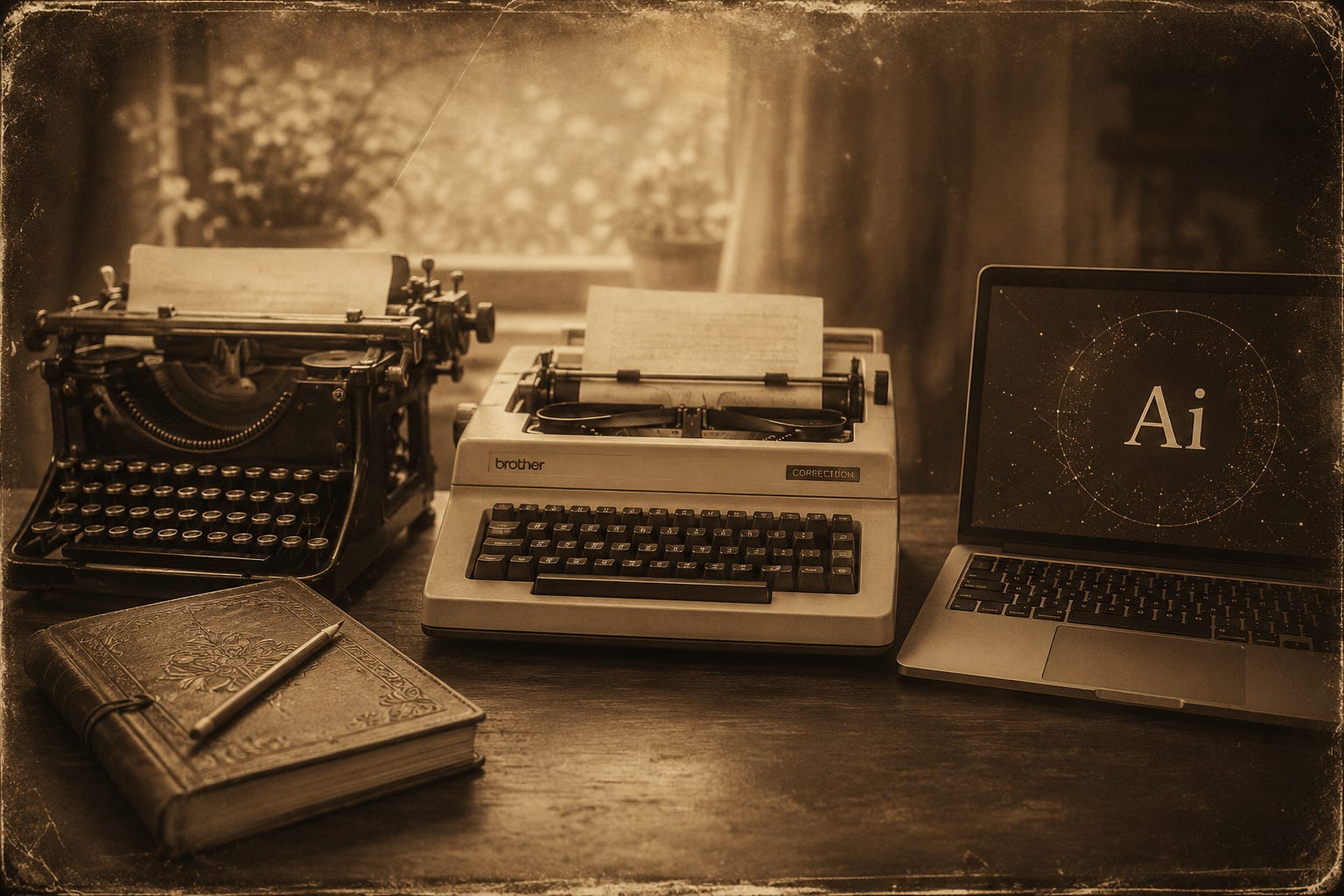
Reading and writing have been part of my life for as long as I can remember. I learned to read very early, and from that moment books became my happy place. Language fascinated me, and writing became the place where I felt most at home. It was where I could think most clearly, express myself most honestly and make sense of the world around me. Journaling became the way I untangled my thoughts, understood my feelings and discovered what I actually thought about the world around me. Looking back, I realise that words were never simply something I used; they became part of who I was.
When I was ten years old, my mother sent me to a secretarial course to learn typing. This was long before computers and even before electric typewriters, so I learned on a manual machine, practising until I could type without looking at the keyboard. Eventually I no longer had to think about the mechanics of typing at all. The words travelled almost directly from my eyes and my mind to my hands, and that skill became an extraordinary gift because it allowed my thoughts to keep flowing without interruption.
Then came my first electric typewriter, and it felt revolutionary. Suddenly writing became easier, faster and more flexible, and I embraced every new possibility it offered. By then I was already teaching aromatherapy, so I wrote all of my course material on that machine, along with articles, research papers, essays and chapters for other people’s books. Writing was never a task to be completed. It was one of the great pleasures of my life.
When computers arrived, they opened an entirely new world. For the first time I could edit without starting over, move paragraphs, reshape ideas and refine my work until it said exactly what I wanted it to say. My writing expanded because the technology removed many of the practical limitations, allowing me to take on larger projects.
One of those projects was a book on perfumery. I wrote several chapters and eventually handed them to an editor, who came back with an enthusiastic response. The writing was strong, they said, beautifully done, and they encouraged me to continue because they wanted to see the finished manuscript.
But life took an unexpected direction…
Around the same time as I entered post menopause, with all what that entails, I was diagnosed with hypothyroidism and Hashimoto’s disease. Those conditions affected almost every aspect of my life, but the greatest shock was what happened to my mind. Until then I had never really understood what people meant when they spoke about brain fog. Suddenly I understood it all too well.
Words disappeared just as I reached for them; I couldn’t remember what I had done earlier that day, and names refused to appear. I remember one conversation when someone mentioned an actress. I could picture her face perfectly. I knew exactly who she was, yet I could not remember the name Julia Roberts. I spent three days trying to remember it. It circled around in my head because I am like a dog with a bone when I know I know something, and then, three days later, it suddenly appeared - in the middle of a sleepless night. That experience says more about the severity of my brain fog than almost anything else.
It was frightening because I believed there must be something seriously wrong with me. My doctor explained that this was part of living with thyroid disease and getting older, but knowing the reason did little to ease the grief. I felt as though I was losing an important part of myself, something that I always could rely on.
Over the years I worked hard to restore my health, and in many ways I succeeded. I feel stronger, healthier and more energetic than I once imagined possible, yet the brain fog has never disappeared completely. It is far better than it was, but I still lose words. My memory is less reliable than it once was, and although I have spoken four languages for much of my life, I no longer find it easy to follow the thread from one language to another until the right word appears. That effortless relationship with language has changed and my memory retention is diminished.
Not long ago I found the old perfumery manuscript again and began reading the chapters I had written all those years earlier. I found myself thinking, “This is so good. Did I really write this?” It flowed beautifully, it had depth and clarity, and I could hear my own voice in every sentence. I enjoyed meeting the younger version of myself through my own words, and only then did I realise how completely I had lost my gift of writing. The grief was profound.
The loss hit me with an intensity I had not expected because writing has always been woven into my identity. I have been reading and writing since I was five years old, and today I am sixty-five. That is sixty years of thinking through language, of finding joy in shaping ideas into words, and of trusting that whenever I needed them, those words would be there. Realising that illness had changed that felt like losing a part of myself.
Enter AI
At first I paid very little attention. Like everyone else, I heard people talking about artificial intelligence, but I wasn’t particularly interested. It sounded like another new technology that everyone was excited about. It wasn’t until I was attending a training course where AI became part of the conversation that curiosity finally persuaded me to explore it for myself.
It didn’t take long before I realised I had discovered something really useful.
If I had lost the use of my legs, I would never have hesitated to use a wheelchair. If I needed support to walk, I would gladly accept a crutch. In exactly the same way, AI became a support for my mind. I invested time teaching it how I think, how I write, the rhythm of my language, the subjects I care about and the voice that has been developing over a lifetime. Little by little I taught it how to support the places where my brain now struggles.
The greatest gift AI has given me is that I no longer have to struggle against my limitations in order to write. Speaking is easier for me than typing because my thoughts continue to flow naturally when I dictate. If I stop to write every sentence myself, I often lose the thread of what I was trying to say before I have reached the end of the paragraph. By speaking, I stay connected to my thinking, and AI helps me transform those spoken thoughts into written language.
I want to be completely transparent about how I use AI because it has become an important part of my writing process. AI does not think for me, develop my ideas or create my stories. Its role is to support the parts of writing that illness has made more difficult, allowing me to express what I already know, what I have already lived and what I genuinely believe. The wisdom comes from my own experience, the stories come from my own life, and the voice is mine. AI simply helps me bridge the gap between what is in my mind and what my brain is still able to remember long enough to place on the page.
Looking back, I realise that AI is simply the latest tool in a long line of tools that have helped me write. First there was touch typing, then the electric typewriter, then the computer, and now AI. None of those technologies created my ideas or gave me my voice. They each allowed me to communicate more freely than I could before, and each of them asked something of me in return. I had to learn how to use them before they became a natural extension of myself, and AI has been no different.
What I lost was never my imagination, my curiosity or the life I have lived. Those were always there. What illness stole was my ability to reach them as effortlessly as I once could, and AI has helped me find that path again.
I still have stories to tell. I still have experiences worth sharing. I still have things that matter deeply to me, and after believing for a long time that I had lost the ability to write them, I have found my way back.
That is why I use AI.
That said, I do use AI for images. I get what I want and I can be sure that I am not infringing on any copyright. And I don’t really care if they are blatantly AI - because they are…
I could not agree more. I will often write the story and ask for some clarity or suggestions. Wouldn’t an editor do that??
So much of what you describe was my experience as well, Anna. Learning to touch type when young means that today I am more efficient at typing what I need to express than speaking. Moving from the manual to the electric typewriter and then the computer. And then discovering AI and using it to help structure a photographic memoir that I had dreamed of writing for more than forty years. And now, Substack where I am finding my voice through my personal stories. If something I say touches just one person it is a good day.