

In 1821, French physician Charles-Pierre-Louis de Gardanne coined the term menopause, and something that had belonged to women since the beginning of time was taken from us and placed into the hands of medicine. It had enormous consequences for women. A profound transition in a woman’s life, an initiation, threshold, doorway into her elder years, became defined as biological failure, deficiency and decline.
And with that change, seeping into the fabric of society, the post-menopausal woman herself was diminished. The place she had once occupied, with her experience, knowledge, authority and freedom from childbearing, disappeared beneath a medical story about what she had lost. Less fertile became less feminine, less desirable, less useful, less relevant. Medicine gave authority to a story that diminished women at precisely the age when their accumulated experience could have given them greater authority. We are still living with the consequences of that story today.
We are taught all about how to become women, but almost nothing about what happens after our fertile years end. Youth is celebrated, motherhood is sanctified and the post-menopausal woman is made increasingly invisible. We hear about ageing, decline and everything we are supposed to be losing, while the extraordinary changes taking place within us are barely acknowledged.
Yet so many of us experience something very different. We become more honest, more discerning and far less willing to accept what drains us. The need to please begins to lose its grip and the roles we have performed for decades start feeling uncomfortable. Something is changing in us, and we have almost no language for what that change might mean.
This is why I am so interested in the Goddess Hera.
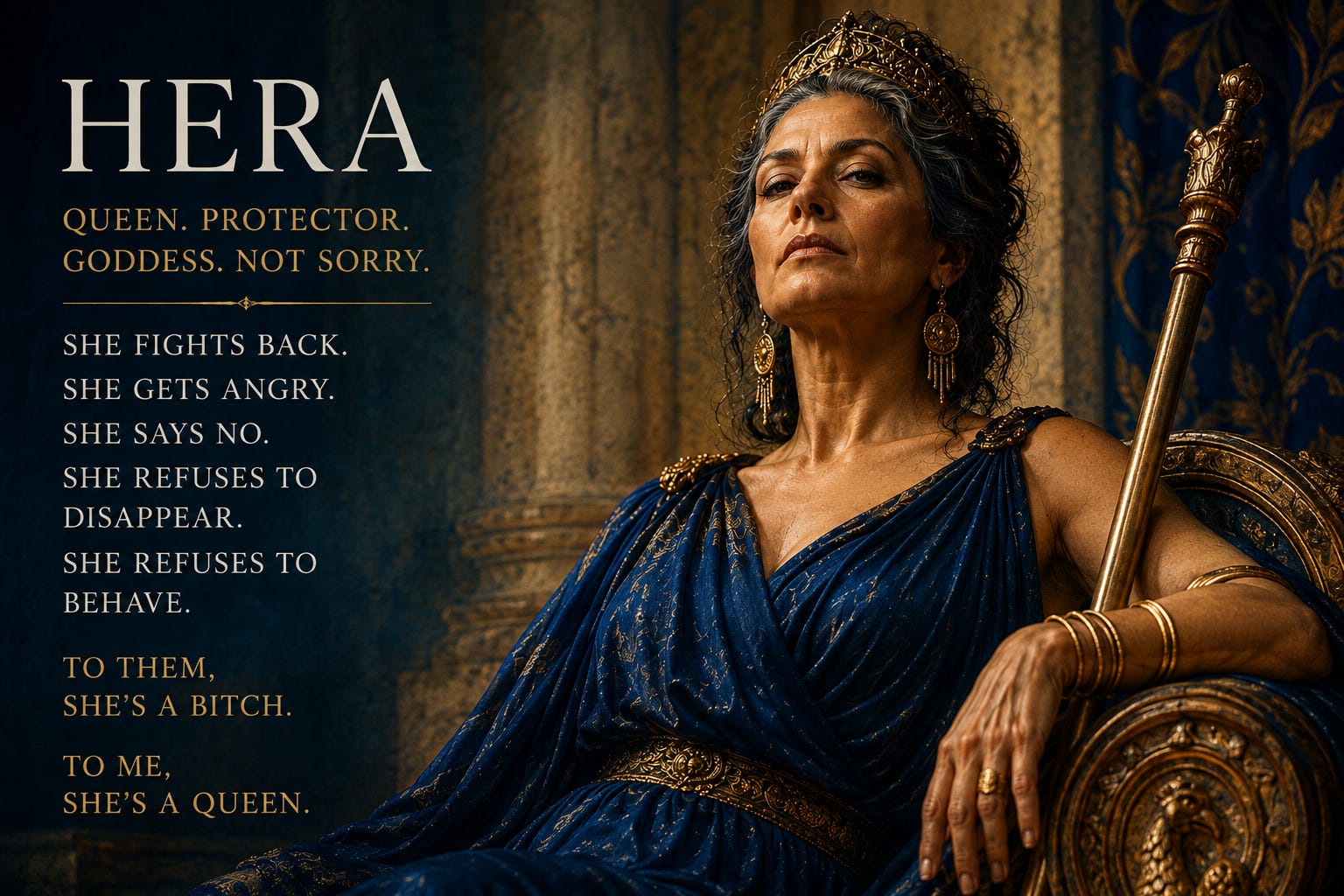
I believe Hera was one of the oldest and most revered goddesses of ancient Greece. She was worshipped as a Queen in her own right, a powerful protector of women, marriage and lineage. And then look at what happened to her. The Queen became the jealous wife, raging while Zeus fucked his way through Greek mythology. Her power became anger, her authority became bitterness and eventually she was reduced to the archetype of the bitch.
I find that extraordinary because Hera’s story mirrors what happened to women. As patriarchal power grew, the stories told about powerful goddesses changed with it. Female authority became something threatening. The sovereign woman became difficult, the angry woman became irrational and the mature woman with power became dangerous.
We still live inside those stories today.
A woman who no longer organises her life around being chosen, needed or approved of becomes much harder to control, and that can make men uncomfortable. A woman who no longer needs male approval, who isn’t competing to be chosen and is becoming less willing to accommodate everyone around her, changes the balance of power.
During our reproductive years, so much of our energy is directed outwards. We nurture, adapt, smooth over conflict, maintain relationships, regulate the emotional atmosphere around us, stay desirable and carry an enormous amount of invisible labour. We learn this so early that most of us don’t even realise we are doing it. It becomes part of being a woman, a good woman, and we get very good at it.
Post-menopausal women talk about becoming clearer, fiercer and much less afraid of disappointing people. Things we have put up with for years suddenly become unbearable. We start saying no. We want more space. We become more protective of our time and energy and less willing to spend either on things that no longer matter to us. And with that can come an enormous grief, because we begin to see how much of ourselves we have given away over the years to keep the peace, maintain relationships and make everyone else comfortable.
Menopause changes our bodies, but it can also shake the foundations of who we thought we were. The good girl, the peacekeeper, the caretaker, the woman who could always be relied upon; suddenly we may not want to be her anymore.
And this is why Hera’s anger is so telling.
We are taught to fear female anger, especially the anger of older women. An angry young woman might still be passionate or fiery, but an angry older woman is bitter, difficult, hormonal, a hag, a bitch. We have an entire vocabulary for putting her back in her place.
But when I look at Hera, I understand her anger. Of course she is fucking angry. Look at what happened to her. Look at what was taken from her. I see the anger that comes with betrayal and imbalance, but also the grief of being diminished, rewritten and made smaller than you are. And I think many women recognise something of themselves in that.
There is wisdom in anger. Sometimes anger is clarity. It is the moment when we finally see what we have accepted, what it has cost us and what we are no longer prepared to tolerate. And it helps us to move forward.
I think one of the realities of post-menopausal life is that women become “less manageable”. We stop apologising for needing space, become more selective about where our energy goes and increasingly unwilling to make ourselves smaller so other people can remain comfortable. We have spent decades learning how to accommodate, and suddenly we don’t want to anymore.
And that can be threatening. Our culture still expects a certain amount of compliance from women, even if we don’t like admitting it. So when an older woman stops complying, she is rarely celebrated for finally knowing her own mind. She becomes difficult. Selfish. Angry. A bitch.
Sounds a lot like Hera.
And yet, talk to women in their fifties, sixties and beyond and so many will tell you that despite all the challenges, they feel more like themselves than they ever have before. More real. There is a freedom in caring less about being approved of and more about whether your life actually feels like your own.
This is why Hera has become such an important symbol for me. She fights back. She gets angry. She says no. She refuses to disappear and she refuses to behave. I love that about her. She is strong, powerful, flawed and furious, and to me she is a beautiful symbol for the post-menopausal woman.
To a male-centric society she’s a bitch. To me, she’s a Queen.
And this is exactly why mature feminine power has been distorted in mythology and in our culture. Because a woman who truly belongs to herself changes the balance of everything around her. She knows what she knows. She decides where her energy goes and what she wants.
She cannot be used anymore.
And there are a lot of us. We are living longer than generations of women before us and may spend thirty, forty, even fifty years of our lives post-menopausal. Think about that. An entire lifetime after our reproductive years are over. Yet we are still being handed that same miserable old story about decline, as though the interesting part is behind us.
But I see something completely different: Women are building businesses at sixty, writing books at seventy, studying, travelling, falling in love, changing their minds, rediscovering their bodies, their voices and their desires. We have decades of experience behind us and the freedom to decide for ourselves what we want to do with it.
We are done being “Good Girls”.
This is what I call our Inner Queendom. We have lived, learned, fucked up, succeeded, failed, loved, lost and gathered a lifetime of experience. We know things now that we could not have known at thirty or forty, and I think it is time we trusted that.
We are tapping into a different kind of power, the power that comes from knowing who we are and belonging to ourselves.
And that is why I called this place HERA.
So tell me, where in your life are you still performing the version of you that keeps everyone else comfortable? Hit reply or drop it in the comments. I read every one.