
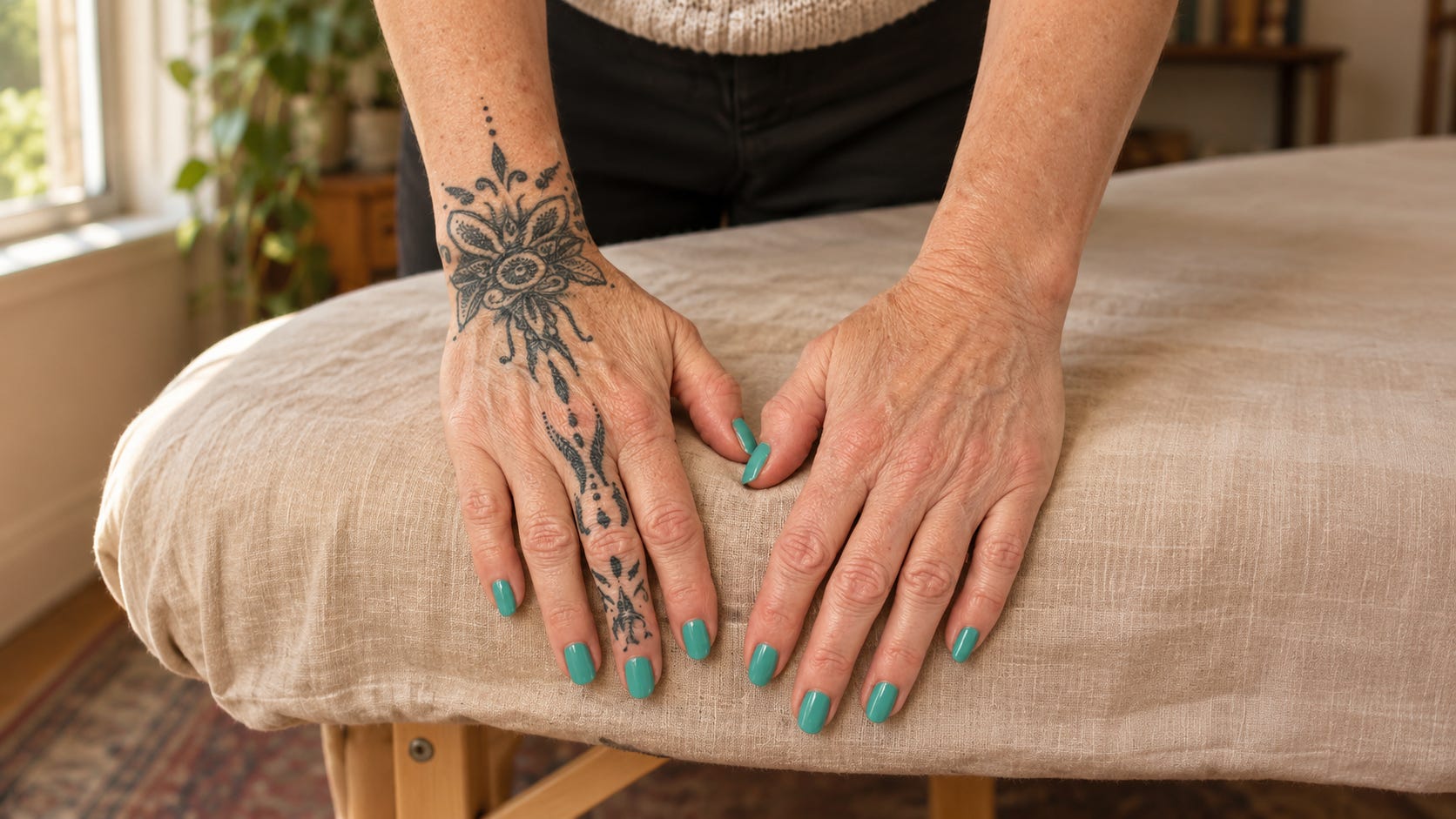
It was a good massage. I’d been doing treatments for over thirty years, and when I worked with someone, I gave them my full attention. I used to say that I left my ego sitting on a stool outside the door. I was there with the person on the table, taking in what I could see and hear and feel, and the whole space was theirs. That’s what I mean by non-attachment. I could care deeply about the person and leave them free to discover what was happening for them without bringing my own ideas about what ought to happen into the room. In my experience, that freedom is what makes it possible for someone to grow.
That day, right in the middle of the massage, I fell out of that state and landed back in myself. It was so sudden and so physical that it took me completely by surprise. There had been no lead-up to it that I was aware of. I was still giving the massage when I felt, with my whole body, This has to stop.
It was the last massage I ever gave.
I could have dismissed it. There were perfectly good arguments; I need to work. I need to make money. This is my job. For over thirty years I’d worked with people physically in all sorts of ways, from facials and full-body massages to wound care. I was good at it and I had a business built around it. If I’d carried on, I could have given a good massage the next day as well. I also know what it would have cost me to keep overriding what I’d felt, and I doubt I’d have done my clients any favours in the long run.
I spend a lot of time in contemplation, and paying attention to signals and impulses is part of how I work and how I live. I couldn’t tell you exactly what happened in my body that day. I think the body carries a great deal of what we’ve experienced, including things we haven’t yet put into words. We think we’re so clever because we can reason our way through a problem, and there I was with a piece of knowledge that had arrived, before I’d even thought to ask the question. It told me what had to stop. I was still going to have to work out why.
There was an empty space where my old way of working had been. My clients booked a treatment with me knowing it included both guiding and massage. We began with the guiding, and the massage gave them time to settle with what had come up in our conversation. Over the years I’d come to see that the guiding was what moved things forward in their lives. Sometimes we’d reach the point where something had opened up for them, and that was when it was time to get on the table. I could feel that some people picked up whatever they’d put down during the conversation and carried it out with them, so that when they came back we’d begin again. I wanted to stay with what had opened up and see how far we could take it.
It took a while for people to come for the guiding itself. Then one day I was sitting across from a woman and we reached the point where I would usually have moved to the massage. We stayed with the conversation and had time to work with what had come up. I remember thinking, Yes, this is it. I could take the work the whole way, to something grounded that a person could carry into her life. That was the part of my work I’d wanted more of, and it had been there in the room with me for years.
I think about how easily we can override that first signal. It can be as brief as a moment of reluctance when someone asks us to bake cookies for the sale. We feel that small “no” and say yes out of habit, because someone expects us to and we feel we ought to. And there we are, giving away an afternoon we wanted for ourselves because someone else expected something from us. That’s how easily “I have to” takes over from “What do I want?”
Women have had centuries of practice at staying in the proper lane, because the pushback can be tremendous when a woman changes what she’s willing to do, especially when others have come to depend on her doing it. She can love her home, her friends and the life she’s built and still feel how narrow a lane she has to stay in to keep her place in it. I think that’s worth taking seriously. It’s easy to talk about following what we want when we leave out what it can cost a woman to do it.
There’s a cost to overriding ourselves, too. In my work with women, I’ve seen how the feelings we set aside to meet other people’s expectations can build over time and come out as anger or sadness. And one day a woman hears herself say, “I can’t do this anymore,” and surprises herself with the force of it. If someone asks her why, she may have no idea where to begin. She’s been managing perfectly well as far as anyone can see, and she may still be very good at whatever she’s doing.
I was giving a good massage when I knew I’d given my last one.
At this stage of life, I’m interested in what we can hear when “I should” no longer gets to answer every question for us. For me, that means paying attention to what I want, to an impulse I might dismiss or to the pleasure I feel when I’m doing something I want more time for. When I gave my last massage, I knew nothing about my future. I had to live in that empty space for a while before I could see what I wanted to do with it. I think that’s where many of us find ourselves when we first hear ourselves say,
“There must be something more.”
Anna
P.S. Have you ever wondered what it would feel like to have a space in your life that belongs entirely to you?
Not to your family, your responsibilities, or anyone else’s expectations. Just you.
That’s what we begin exploring in Opening into Her Inner Queendom — three private conversations where I guide you toward discovering your own Inner Queendom, perhaps for the very first time.
I’m opening a number of places for women who feel curious about beginning.
You can read about the sessions here. The three-session experience is €295.
“If there’s a woman in your life who’s spent decades looking after everyone else and is beginning to wonder what the next chapter might hold for her, perhaps she’d enjoy discovering the Inner Queendom. Feel free to send this to her.”