
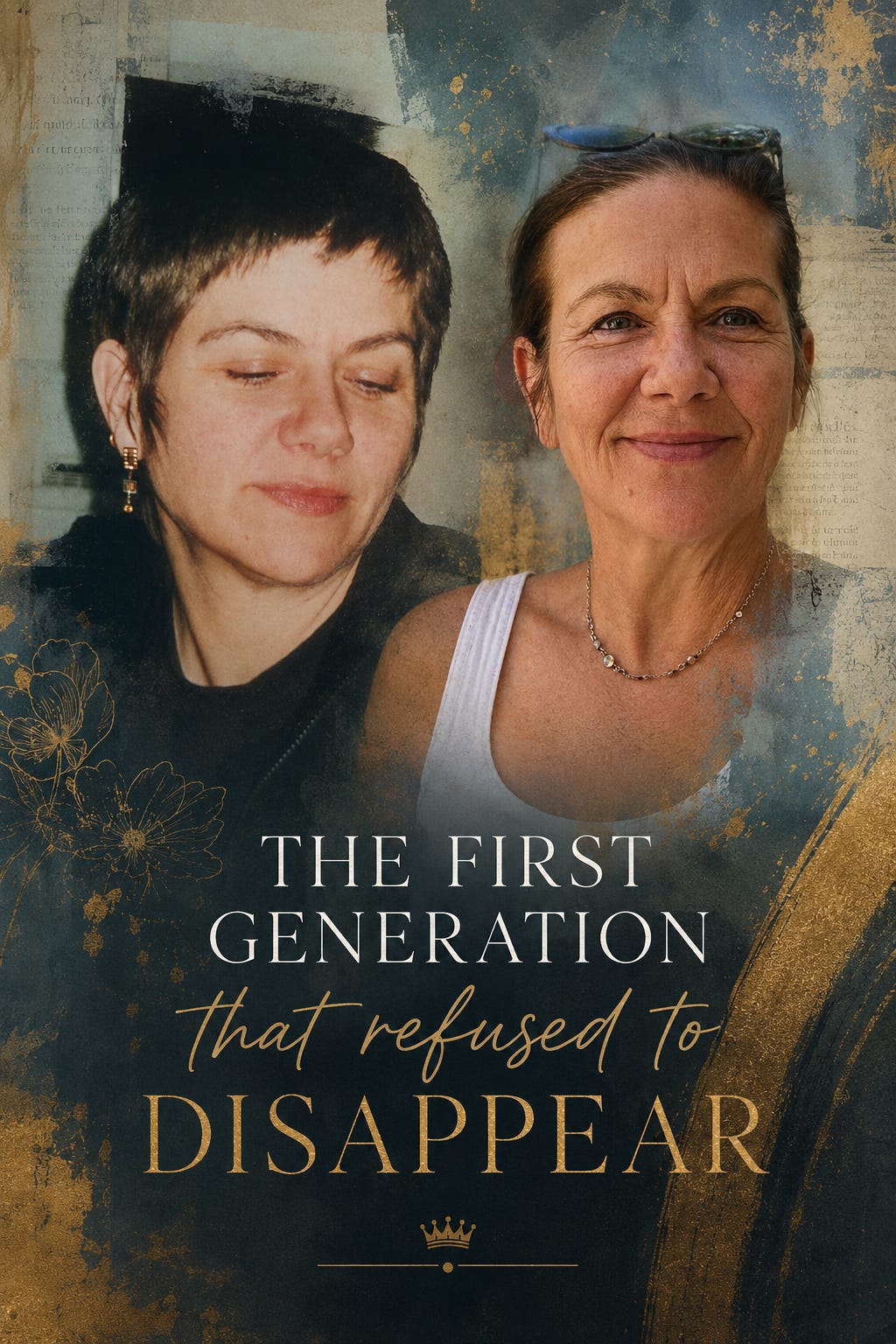
It sounds strange to say because we have always existed, though we have often been almost invisible. Back in the day, if older women appeared in films or stories at all, they were usually cast in very limited roles: the grandmother, the old lady, the village witch, the difficult woman, the patient in the hospital. They were supporting characters, never the centre of the story. And very often they were portrayed in a negative light.
We were young, then mothers, and then we disappeared.
Already as a little girl I understood that beauty was a most important currency in a woman’s life. My mother cared deeply about beauty. She believed a woman should be naturally beautiful, slim and elegant, and she often spoke about the necessity of having the perfect figure. I grew up believing that my waist should measure no more than fifty-four centimetres - without a corset…
That idea stayed with me for years.
I was always small and I did get my waist to 54 cm, gaining the acceptance of my mother, but I still never felt beautiful enough. I loved the feeling of being empty and would often starve myself because it made me feel good. It never developed into a serious eating disorder because I did eat, apart from the bouts of starvation, but the belief underneath it never really disappeared.
No matter what I did, I felt that I fell short of the standard I believed I was supposed to reach and whenever beauty was admired, it never looked like me.
Many of us grew up absorbing the same messages. Sometimes our mothers passed them on because they had inherited them themselves, sometimes we learned them from magazines, films and advertising. We learned to shave, diet, apply makeup, dress correctly and continually improve ourselves. Beauty was presented as something we should pursue every day of our lives.
Behind the scenes, what we were taught about being a woman was ultimately geared towards attracting the male gaze.
We learned that being noticed by men was confirmation that we were attractive and therefore valuable. We were expected to feel flattered by attention that today would be recognised very differently. A man slapping a woman on the bottom was often dismissed as harmless fun or even taken as a compliment. Women were expected to smile, laugh it off and accept it as part of life. We were always measured by the attraction we held for men.
Today we have language for what many of us experienced without ever questioning it. We recognise that behaviour as sexual objectification and harassment. Looking back, it becomes clear how deeply our sense of worth had become intertwined with being desirable in the eyes of others. To the point where many of us accepted behaviour that was disrespectful because we believed it was normal.
And it didn’t stop there.
Everywhere we looked, we were being shown what the ideal woman was supposed to look like. Magazines, advertisements and television held up images that became the standard against which we measured ourselves. I was well into my forties before I realised that the women in fashion magazines had been heavily retouched. Until then I believed they genuinely looked like that, and I measured myself against an impossible standard that nobody could ever reach.
When you spend a lifetime trying to become a woman who never really existed, it changes how you see yourself.
By the time we arrive at menopause we have spent decades believing that youth and beauty are central to our worth as women; then, almost overnight, society changes the rules. The very culture that spent decades telling us to be beautiful suddenly behaves as though we no longer exist. We become invisible and less interesting as we no longer attract the male gaze.
Older women are often spoken about in dismissive or negative ways, as though our most meaningful years are already behind us. Menopause can feel as though you have been ripped apart and put together again in a way you no longer recognise. Everything you believed made you valuable is stripped away and that’s scary.
But now something is finally beginning to change.
For the first time, we are seeing films made by women, for women, starring women in their fifties, sixties and beyond. These women are detectives, adventurers, business owners, leaders, lovers and complicated human beings. They are interesting and vibrant. Yes, and beautiful!
These stories matter because we can recognise ourselves and we can recognise our innate beauty and capabilities. That sense of being at the beginning of something new and exciting.
Films aimed at much younger women can be entertaining, but they do not reflect the lives we are living now. Seeing women of our own generation on screen gives us something we have rarely had before: Visibility and recognition. It tells the world that life does not end after menopause.
For so long, the story of womanhood has followed the same predictable path. A woman grows up, becomes attractive, falls in love, has children, raises a family, and then menopause marks the end of the story. Everything beyond that has been treated as decline, as though there is nothing more to become… Even though we know that menopause is the beginning of the next chapter.
What’s fascinating is how completely this part of women’s lives has been erased. It has disappeared from literature, films, storytelling and culture. When older women do appear, they are often portrayed as people whose meaningful lives are already behind them, as though growth has stopped and there is no future beyond fertility.
That sends a fearful message to young girls and women. I myself was so afraid of growing old as a child. I saw the “old women” around me going invisible, I saw them becoming something that to me was scary. I saw an ending ahead of time.
That is changing, because today we are women in Midlife, not old, but in the middle of life. And that’s a glorious place to be!
When most of us reach menopause, we finally have the freedom to begin something entirely new. Children have grown up, careers are established. We understand ourselves better than we ever did when we were younger and we have more confidence, greater financial independence and way more experience than we had in our twenties or thirties.
We are fit, strong, knowledgeable and we have lived enough life to know what matters and what we want.
We are discovering what we are capable of and that is so exciting! It is an adventure.
This generation of women occupies positions of influence throughout society. We lead businesses, organisations, communities and families. We have wisdom, resilience and perspective that can shape the future in a positive way.
That is why we are the first generation of women to refuse accepting invisibility as we grow older. We are creating new stories, new role models and new possibilities for the women who come after us. And maybe for the first time in centuries, society is beginning to understand something women have always known: Life does not end after menopause. For many of us, it is where the most interesting chapter begins.
We are a generation to be reckoned with and there are a great many of us. Baby Boomers hello!
Love your younger self Anna! ❤️❤️❤️
Wonderfully written Anna! I absolutely agree and am on the same track trying all I can to readjust my life to the new me. I have made very similar frustrating experiences with doctors and read a lot of stuff myself but for me the problems started much before 60. I am anxious to see what more you have to say! Kisses from Germany to a strong and beautiful woman! Female Empowerment!